When you plug in to charge your electric vehicle, the connector you use depends on where you are, what car you drive, and how fast you want to charge. There are many connector types, we will go through them one by one.
North America
Type 1
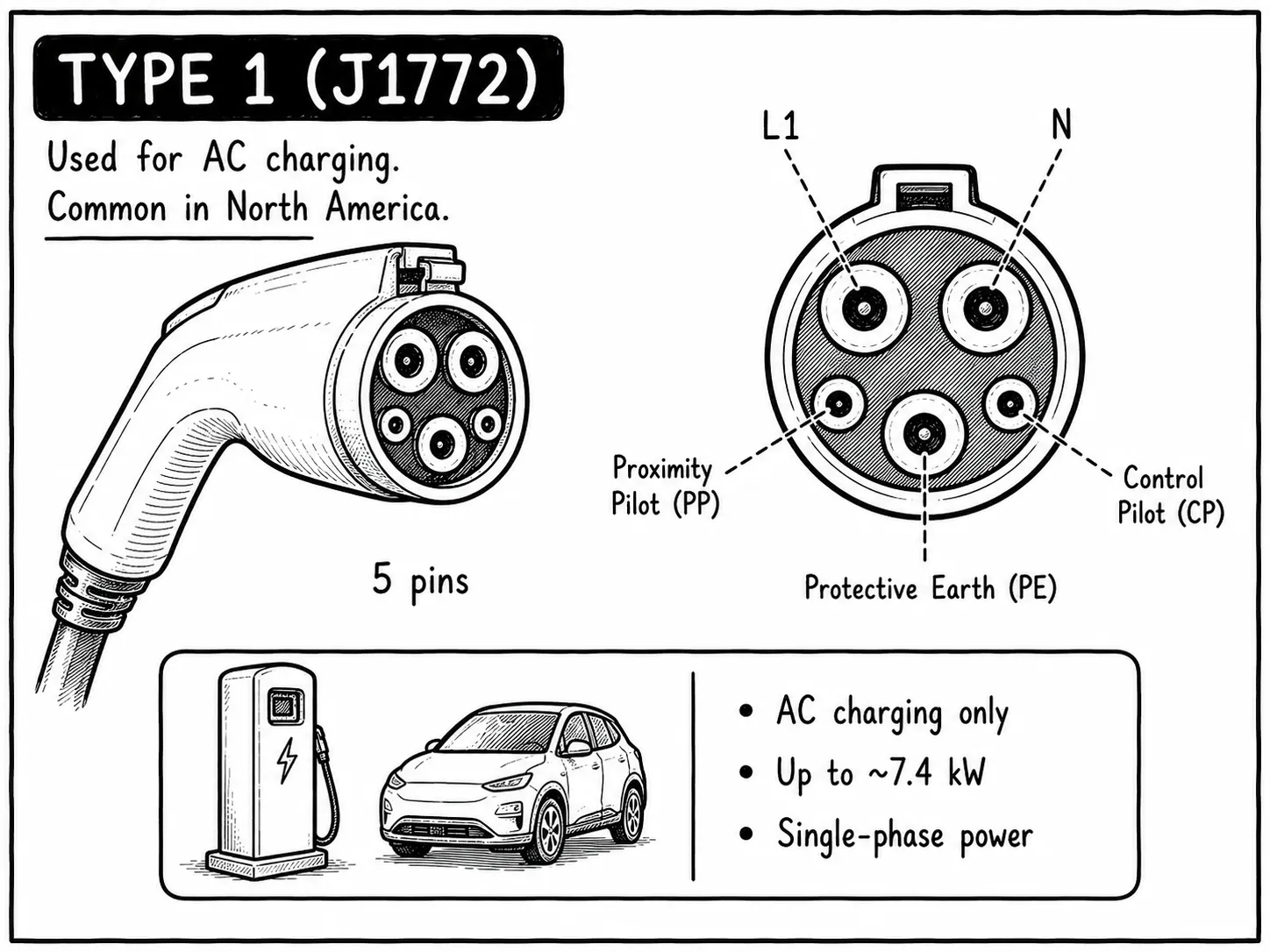
Type 1 is a single-phase AC connector used primarily in North America and Japan. It has five pins and supports up to 7.4 kW of charging power. It is common on older electric vehicles sold in those markets, such as early models of the Nissan Leaf and Chevrolet Volt. Type 1 includes a locking mechanism that keeps the connector in place during a session.
Because it only supports single-phase AC, Type 1 is limited in speed. It is suitable for home charging overnight but is not designed for fast public charging.
CCS1
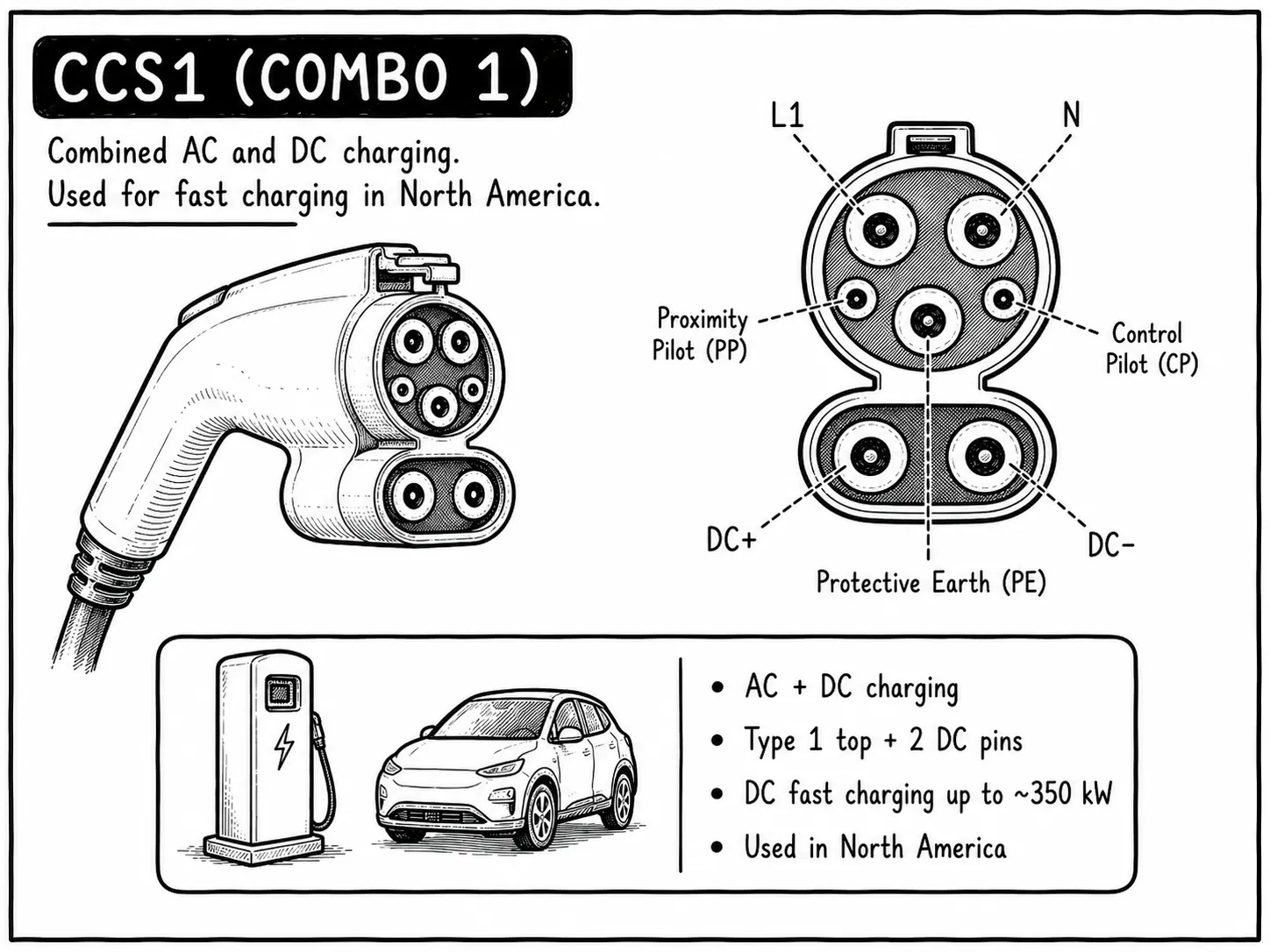
CCS1 is the legacy DC fast-charging standard for North America. It builds upon the Type 1 AC connector by adding two large DC pins at the bottom, allowing the port to handle both slow AC and rapid DC charging up to 350 kW.
NACS
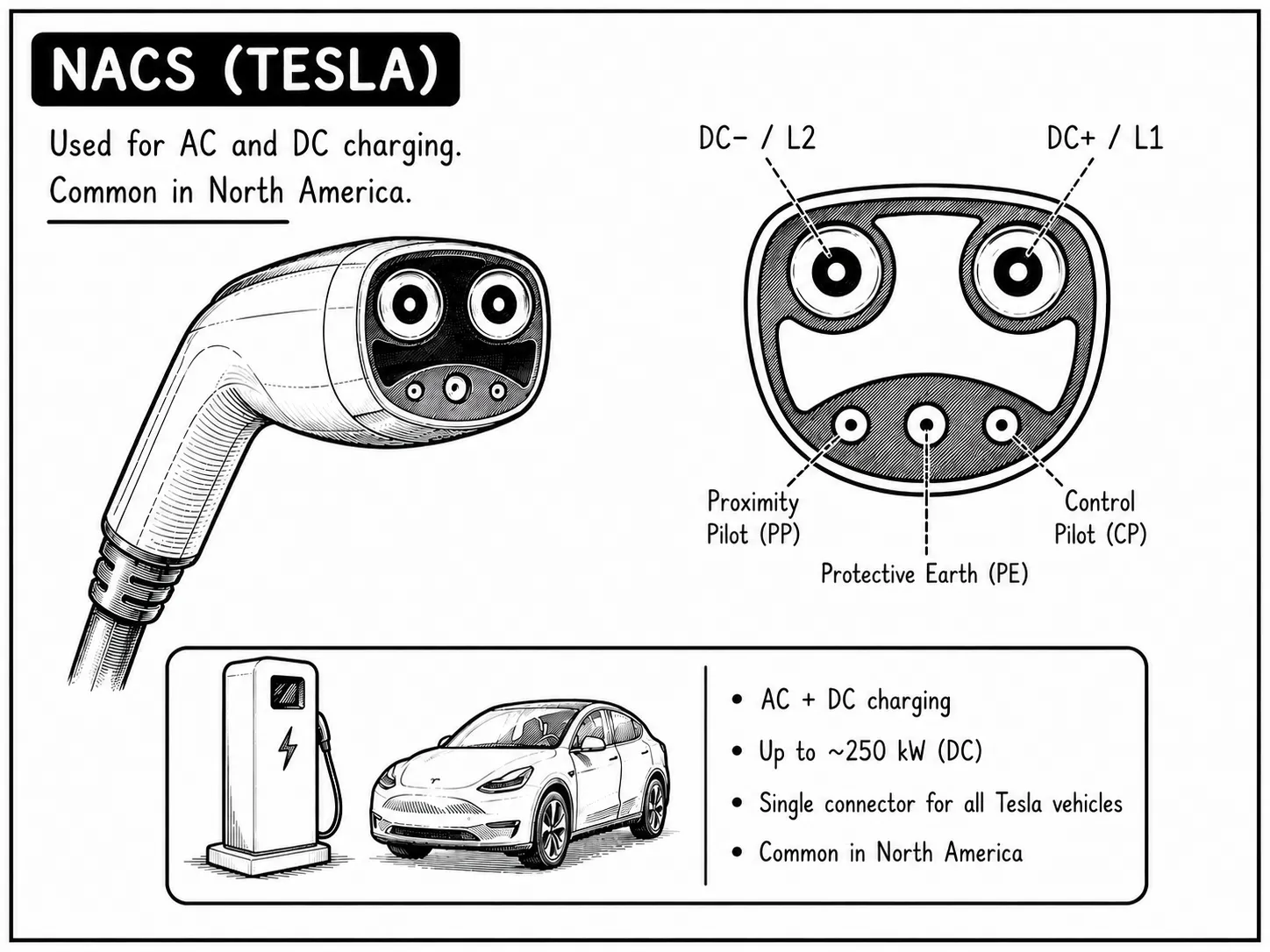
NACS stands for North American Charging Standard. It was originally developed by Tesla for their own Supercharger network and used exclusively on Tesla vehicles for many years. In 2022, Tesla opened the standard to other manufacturers.
NACS is notably compact. Despite its smaller size, it handles both AC and DC charging through the same connector, similar to CCS but in a much smaller form factor. It supports DC charging speeds comparable to CCS.
In 2023, major automakers including Ford, General Motors, and Rivian announced they would adopt NACS. It is now becoming the dominant standard in North America, replacing CCS1 on new vehicles. SAE International officially standardized it as SAE J3400.
Europe
Type 2
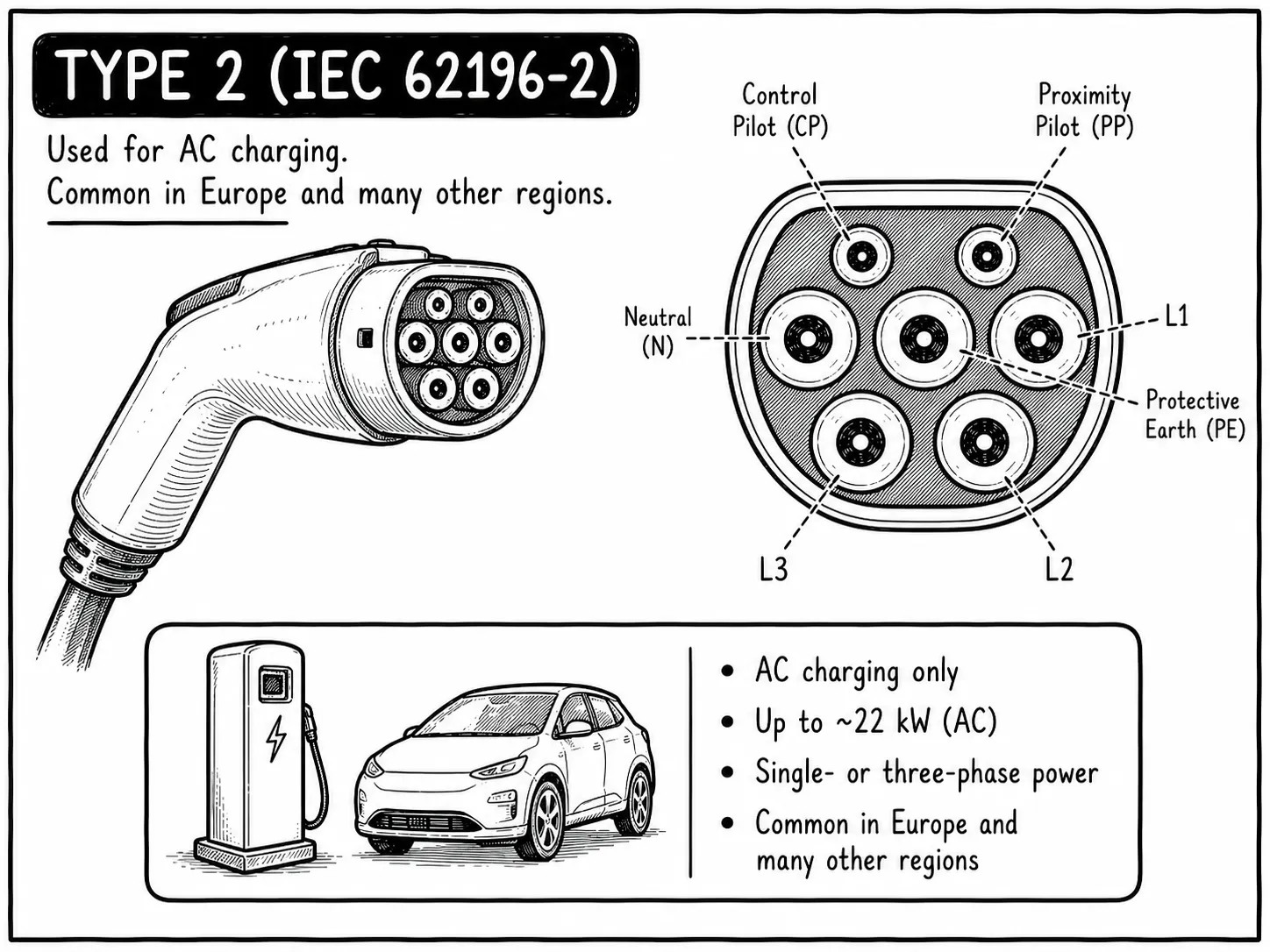
Type 2 is the standard AC connector in Europe and is defined by the IEC 62196 standard. It has seven pins and supports both single-phase and three-phase AC, delivering up to 22 kW. Most public AC chargers, home wallboxes, and workplace chargers in Europe use Type 2.
The European Union mandated Type 2 as the standard connector for EVs sold in Europe, which is why it became so widespread. It is found on vehicles like the Volkswagen ID.4, BMW i4, and Renault Zoe.
CCS2
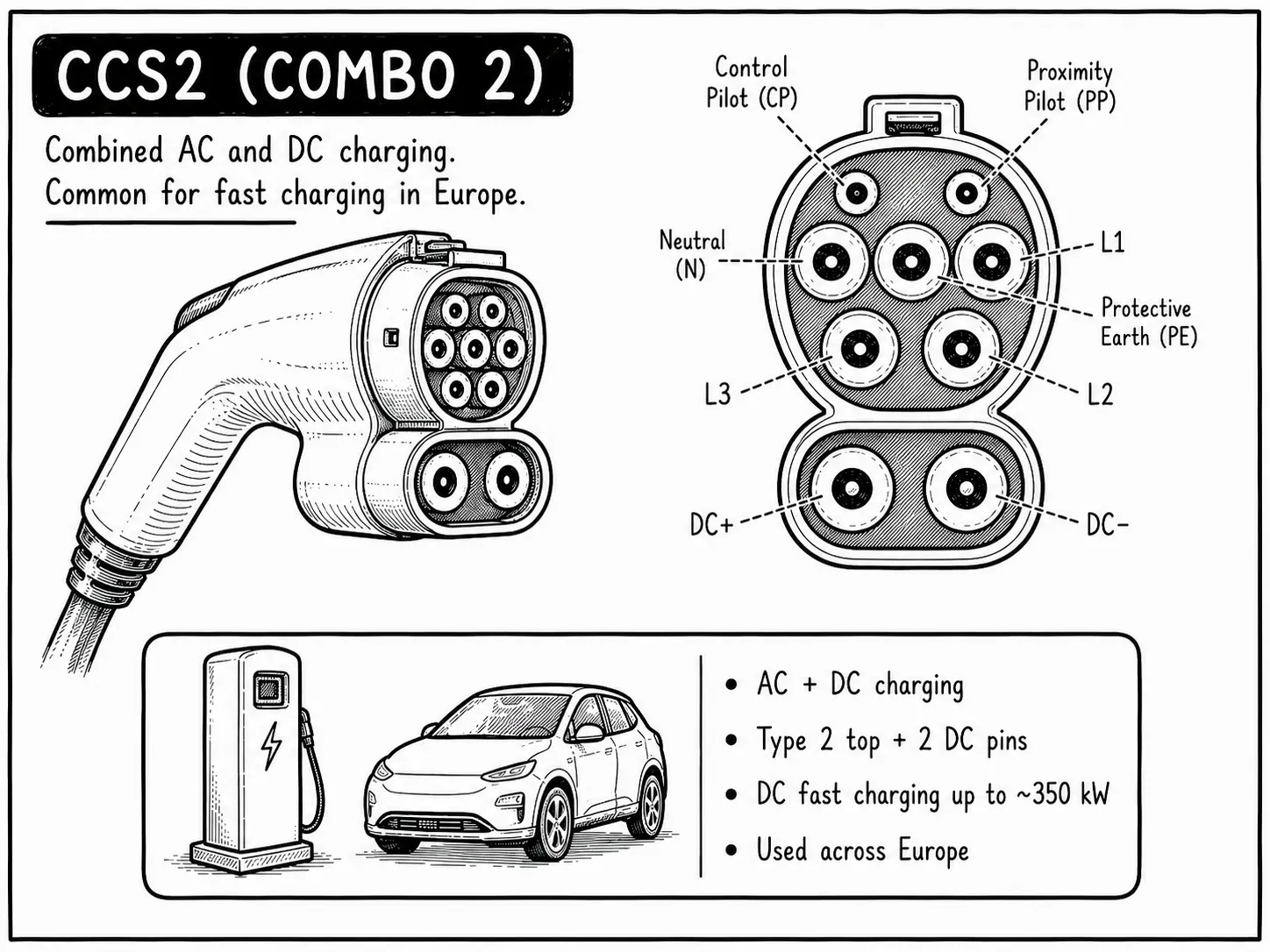
CCS2 is the official DC fast-charging standard for Europe. It combines the European Type 2 AC connector with two lower DC pins. This allows a single vehicle port to accept Type 2 cables for standard AC charging or CCS2 cables for high-speed DC charging up to 350 kW.
Japan
CHAdeMO
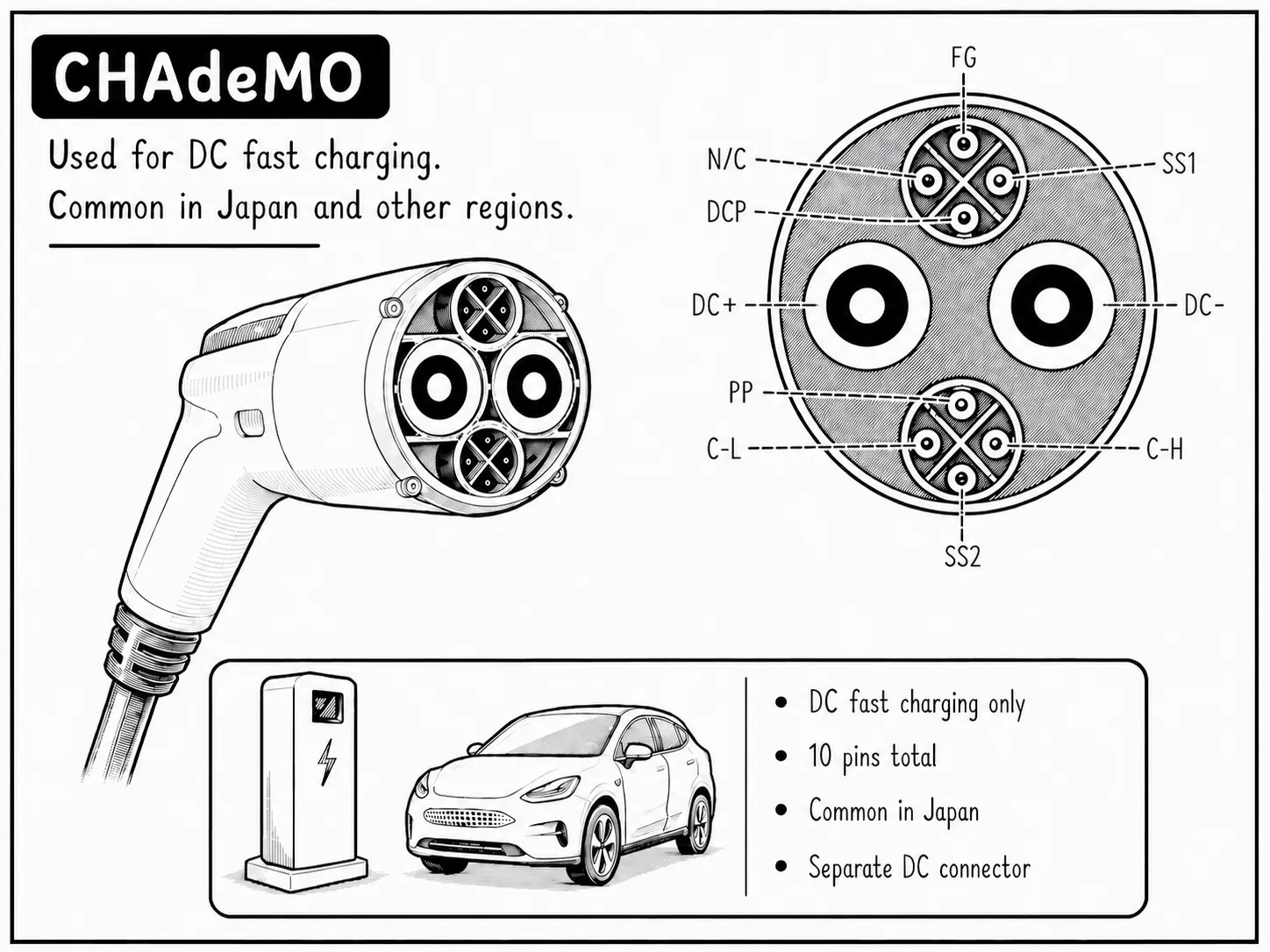
CHAdeMO is a DC fast charging standard developed by a consortium of Japanese manufacturers, including Nissan, Toyota, and Mitsubishi. The name stands for CHArge de MOve. It was one of the first DC fast charging standards and was widely adopted in the early years of electric vehicles.
Unlike CCS, CHAdeMO only handles DC and has no AC capability. It requires a separate dedicated port on the vehicle, meaning a car with CHAdeMO also needs a Type 1 or Type 2 port for AC charging. The connector itself is bulkier than CCS.
CHAdeMO is largely being phased out in Europe and North America. As CCS became the dominant standard, charging networks began removing CHAdeMO posts or stopped installing new ones. The Nissan Leaf was one of the last mainstream vehicles sold with CHAdeMO in Europe.
China
GB/T
GB/T is the national charging standard of China, mandated by the Chinese government for all electric vehicles sold in the market. It covers both AC and DC charging through two separate connectors that share the same standard.
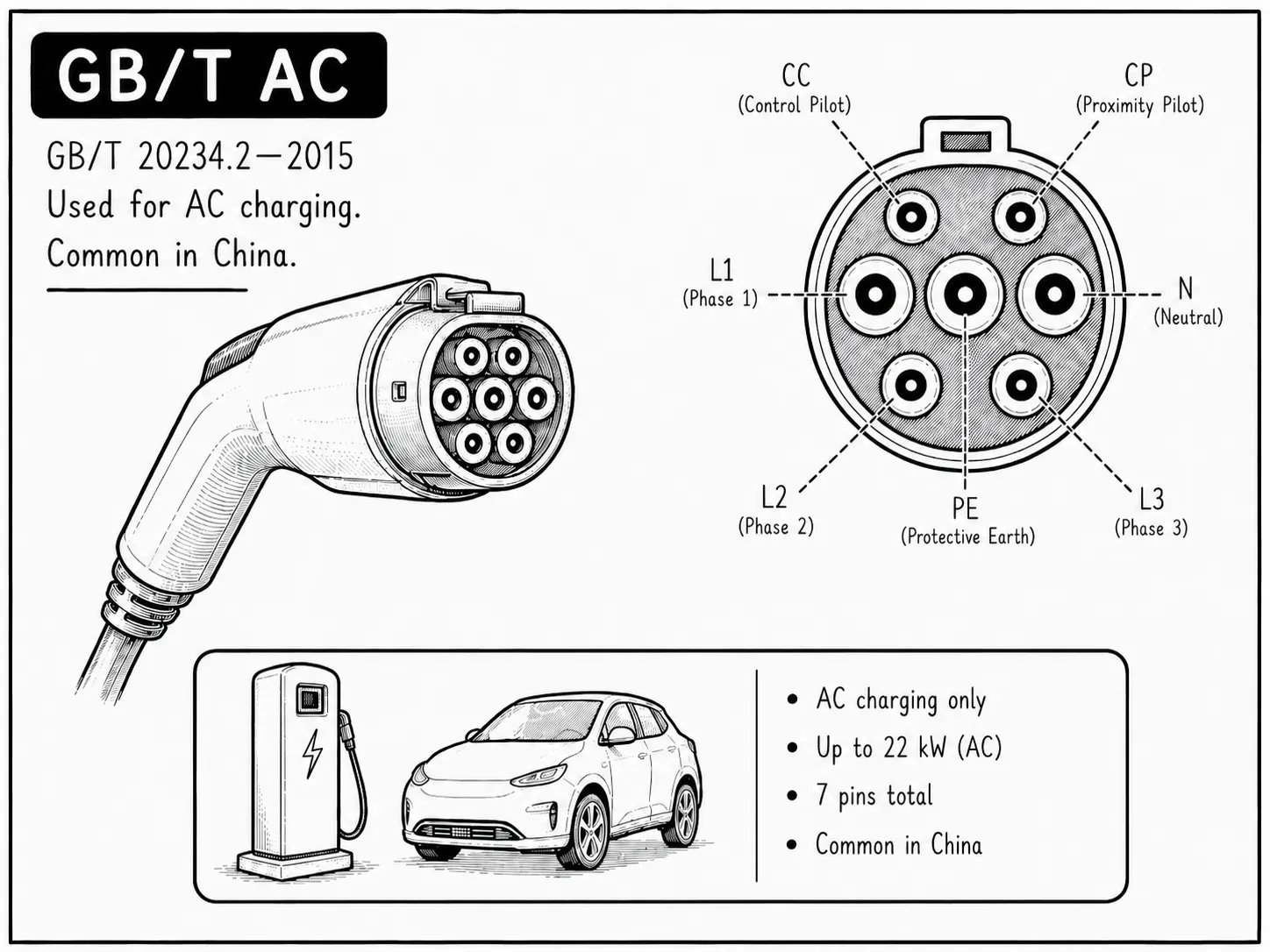
The AC variant supports up to 22 kW, similar to Type 2 in Europe.
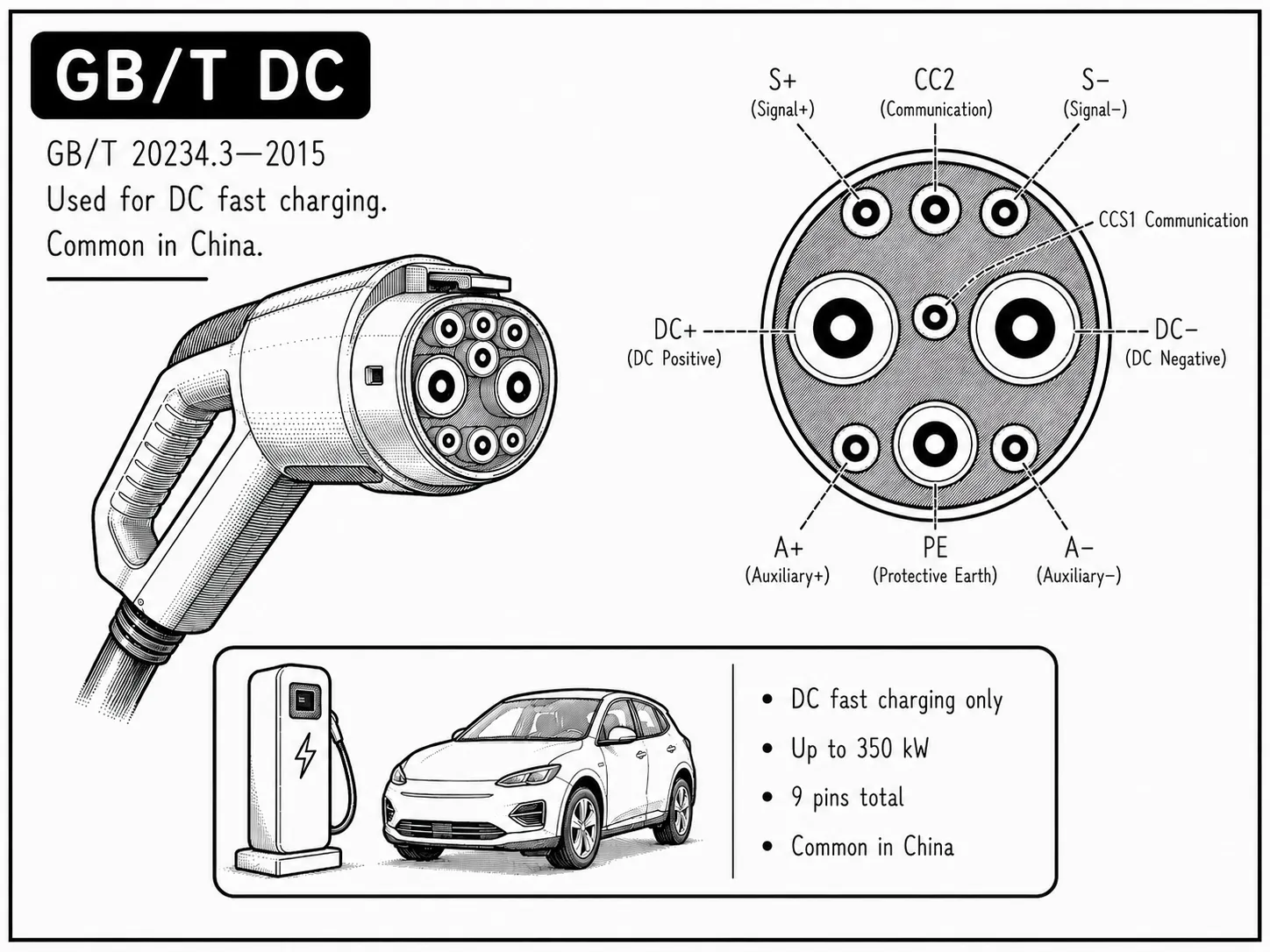
The DC variant supports high-speed charging up to 250 kW. Both use a distinct pin layout that is incompatible with CCS, CHAdeMO, or NACS.
Because China is the largest EV market in the world, GB/T is one of the most widely used charging standards globally. However, it remains largely contained within China. Vehicles sold in Europe or North America do not use GB/T, and Chinese automakers exporting to those markets adapt their vehicles to use the local standard.
Future Standards
ChaoJi
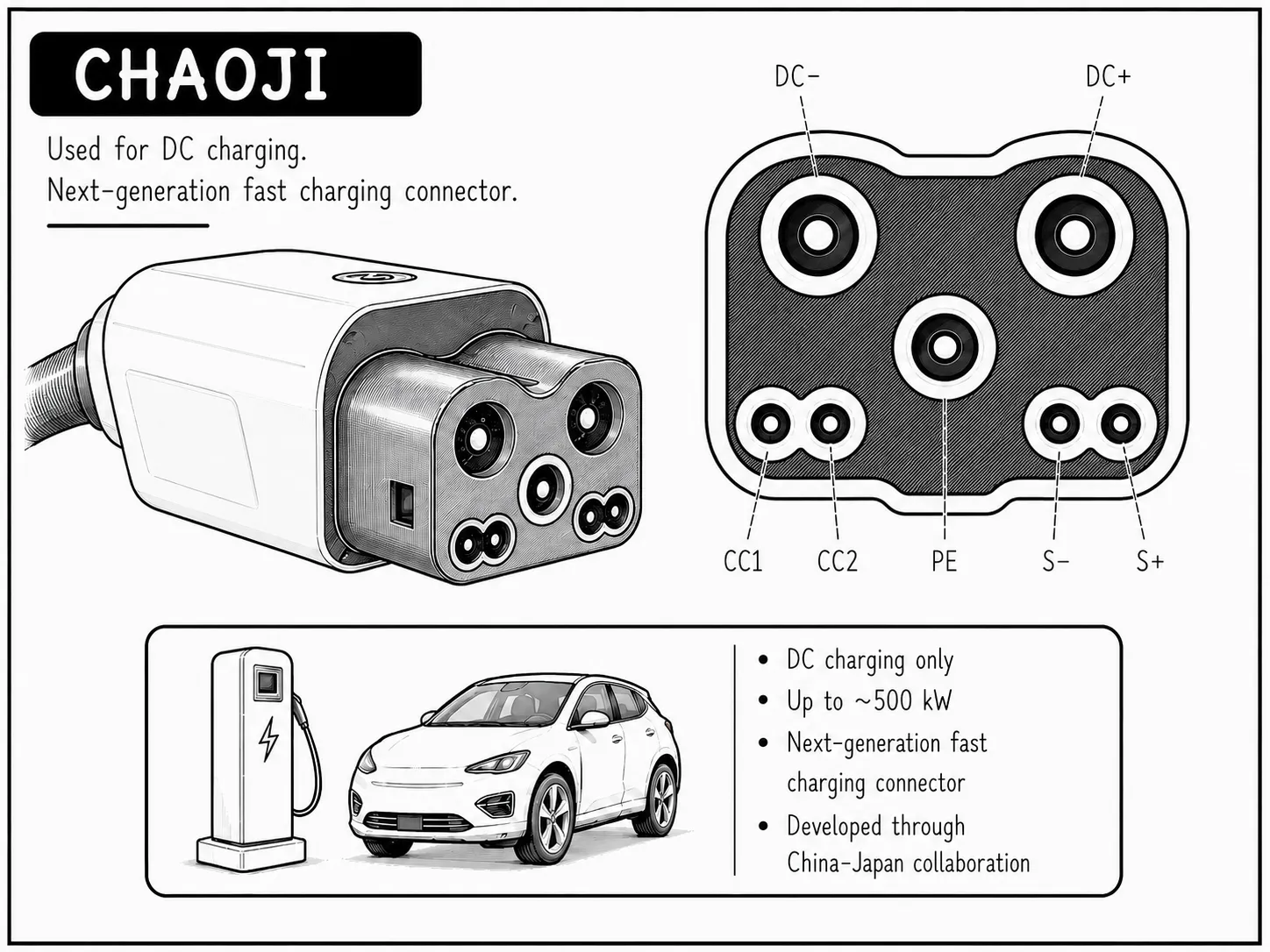
ChaoJi is a next-generation DC fast charging connector being jointly developed by China and Japan. It is designed to succeed both GB/T DC and CHAdeMO, unifying the two standards into a single connector. ChaoJi targets charging speeds up to 900 kW and is built to be future-proof for high-power charging demands. It has been in development for several years but has not yet seen widespread adoption.
MCS
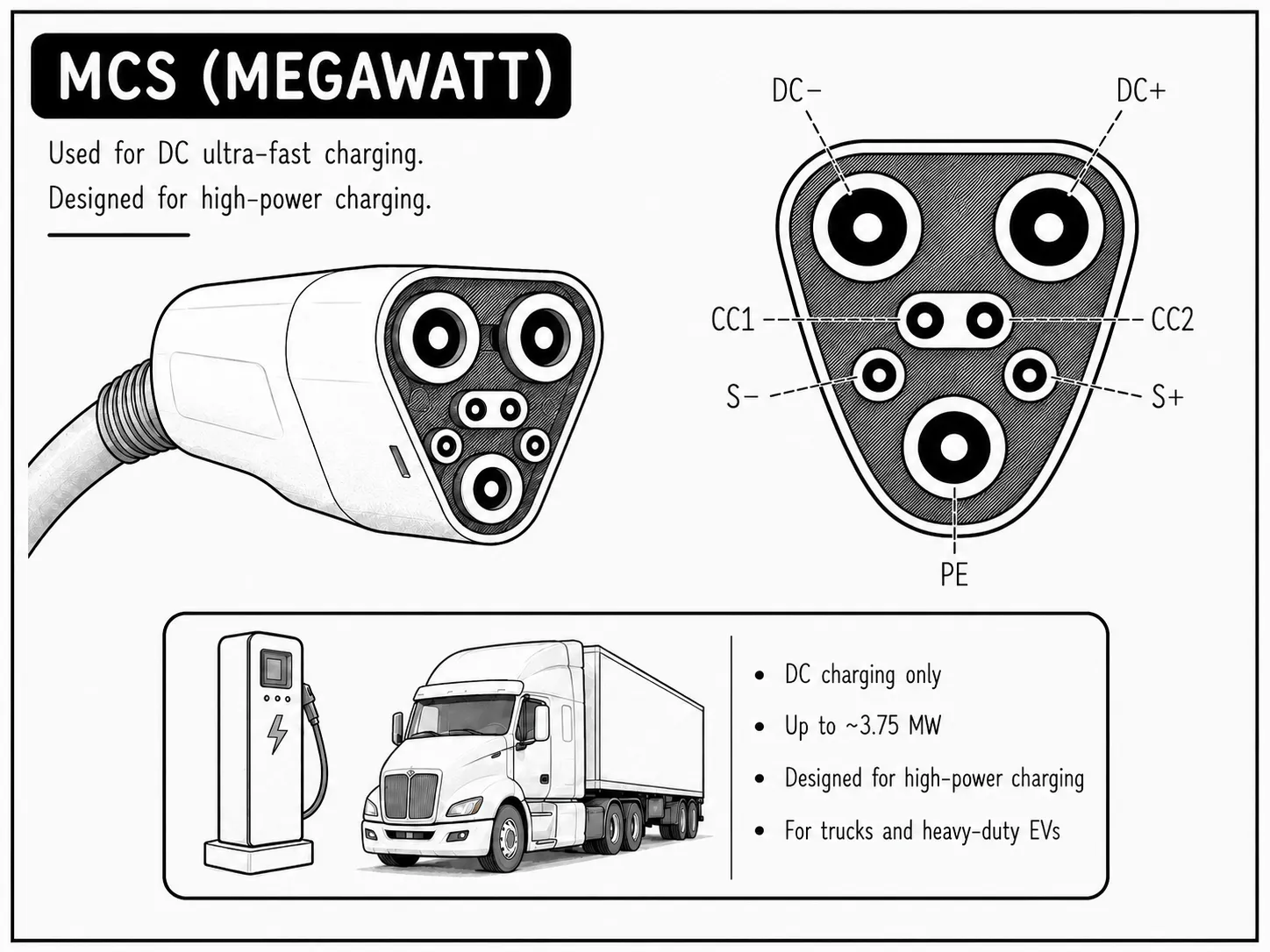
MCS stands for Megawatt Charging System. It is being developed for heavy-duty vehicles such as electric trucks and buses, where passenger car connectors fall far short of what is needed. MCS supports charging speeds up to 3.75 MW, enough to charge a large commercial vehicle in a reasonable amount of time.
MCS is not intended for regular passenger EVs. It is a separate standard aimed at fleet operators and logistics companies. The connector is significantly larger than anything used on passenger cars, reflecting the power levels it handles.
Why So Many Standards
The fragmentation exists because EV charging developed in parallel across different regions and industries. North America, Europe, and Japan each developed their own approaches. Automakers, charging networks, and industry bodies pushed competing standards before any one emerged as dominant.
The result is a landscape where the connector you need depends on your vehicle and where you are charging. In Europe, CCS2 and Type 2 cover almost everything. In North America, NACS is rapidly becoming the standard. CHAdeMO is fading out. The industry is consolidating, but the transition takes time.