AC is an alternating current that flows back and forth, commonly represented as a sine wave. In reality, the grid provides three alternating currents, called phases. Three-phase AC has three sine waves, each offset by 120 degrees. Because of this spacing, when one phase dips, another is already rising. At any given moment, at least one phase is near its peak. This means power delivery never drops to zero, resulting in a smoother and more stable current.
Single-Phase vs Three-Phase
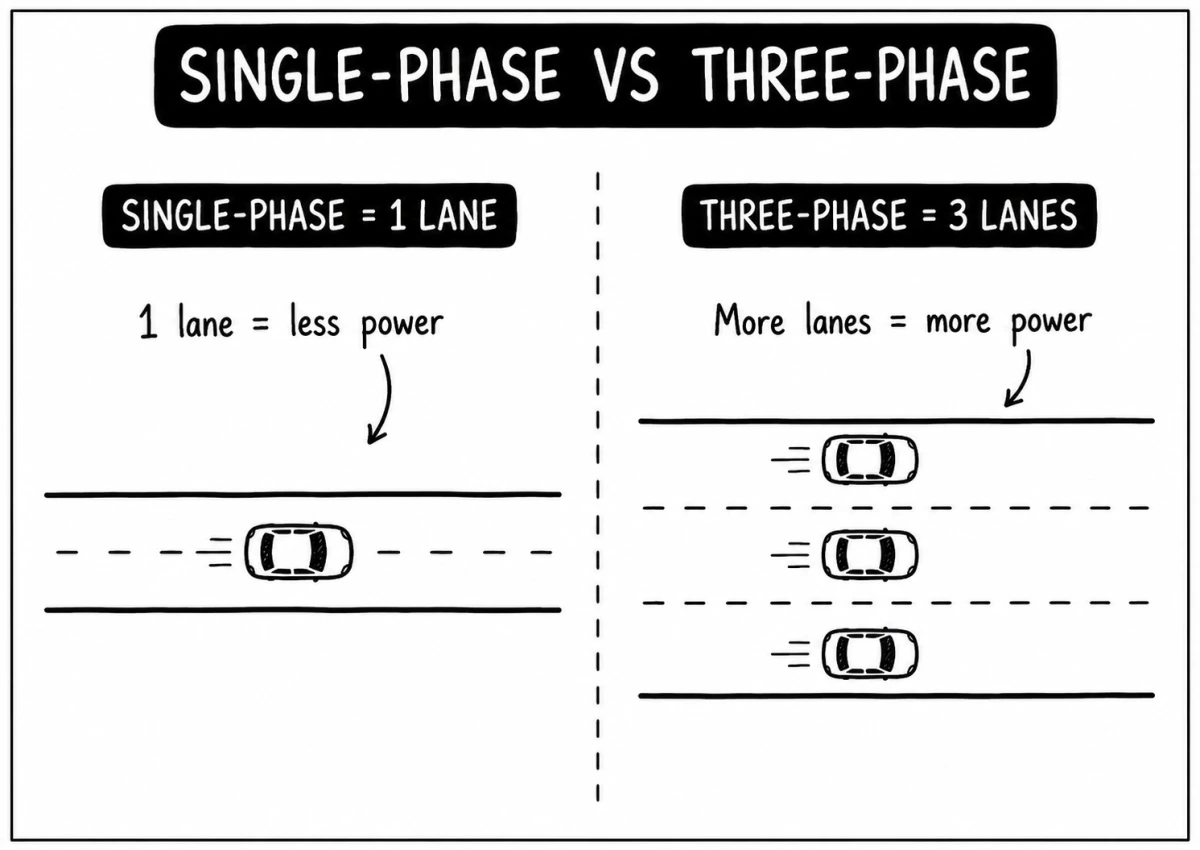
A three-lane road can handle more traffic than a one-lane road because more cars can move at the same time. Similarly, three-phase power can deliver more power than single-phase because it has three separate phases carrying energy instead of just one.
Most homes and small devices use a single phase. While larger buildings like hospitals, factories, and malls use three phases because they require more power. In large buildings, the three phases are split across different parts of the building. Each section draws from its own phase.
What This Means for EV Charging
There are two types of AC chargers, single-phase and three-phase. Single-phase chargers are slower compared to three-phase chargers. A single-phase charger delivers 7 kW while a three-phase charger delivers around 22 kW. The charger passes the three-phase AC to the vehicle using three pins, L1, L2, and L3, which the vehicle converts to DC internally.
DC chargers convert the three-phase AC to DC inside the charger itself, then deliver DC directly to the vehicle. This is why three-phase infrastructure matters for EV charging. More phases means more power, which means faster charging.