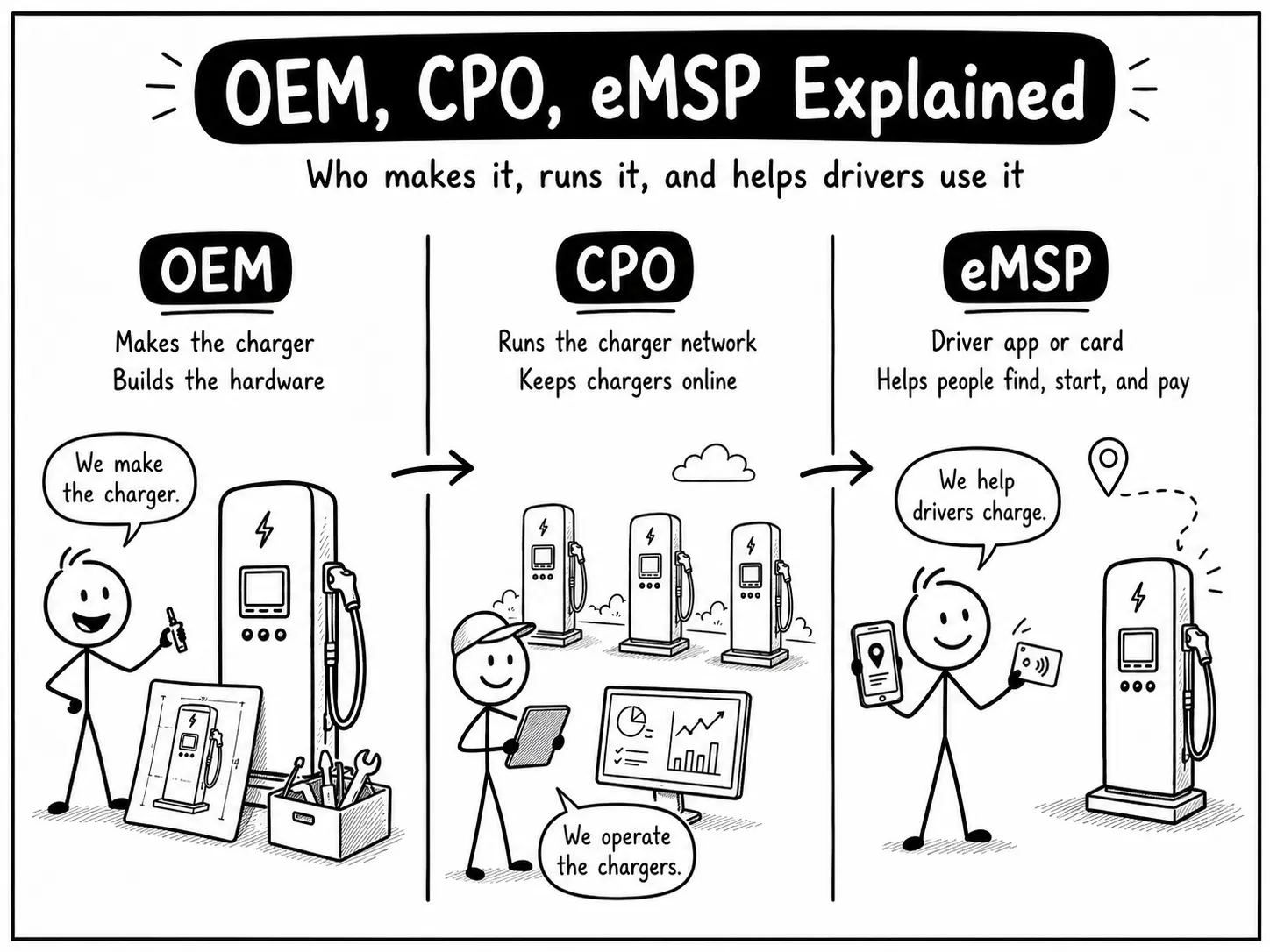
When you charge your vehicle, there are usually two companies involved. One that owns and installs the physical charger, called a CPO (Charge Point Operator). The other handles your account and payment, called an eMSP (e-Mobility Service Provider). But before either of them gets involved, someone has to build the charger. That’s the OEM (Original Equipment Manufacturer).
What is an OEM
In the broad sense, an OEM is a company that manufactures parts used in another company’s products. In the context of EV charging, an OEM is a company that manufactures charging stations. These are companies like Alpitronic, ABB, Kempower, and Wallbox. The term also applies to vehicle manufacturers like BMW and Volkswagen, usually referred to as ‘vehicle OEMs.’
The OEM designs the charger, develops the firmware, tests it, and ensures it operates reliably over long durations. They care about hardware quality, software stability, and certification. Once the charger is assembled, the OEM sells it to the CPO. The OEM does not operate chargers, they build them and hand them over. After the sale, the OEM might still be involved for warranty repairs, firmware updates, or technical support, but the day-to-day management is the CPO’s responsibility.
What is a CPO
A CPO is a company that buys chargers from OEMs and operates them. They choose locations strategically, targeting high-traffic areas to maximize usage. They handle installation, grid connection, maintenance, uptime, and electricity costs. They run the CSMS (backend system) that manages all their chargers remotely. In short, the CPO handles the charging infrastructure.
They generate revenue when the charger is being used. The more sessions are completed, the more revenue they generate.
Examples in Europe: Allego, Fastned, Ionity, EnBW.
What is a eMSP
In most cases, you can’t use chargers directly. You need either an app or an RFID card to authorize and start charging. These are obtained through an eMSP.
An eMSP is the company that the driver interacts with. They provide the app, the RFID card for authorization, the account, the billing, subscriptions, and deals. When you sign up for a charging service and receive a card or download an app, you become a customer of an eMSP. You never deal with the CPO directly.
Examples: Shell Recharge, Plugsurfing, Maingau, ADAC e-Charge.
Why the Separation
Designing and manufacturing reliable charging hardware requires expertise in electronics, firmware, and certification. Installing and maintaining charging infrastructure across the country requires expertise in managing charger hardware, contracting, and grid knowledge. Building a consumer app to handle payments and manage driver accounts requires software and customer service expertise.
Most companies are good at one at a time. Not all.