Analogy
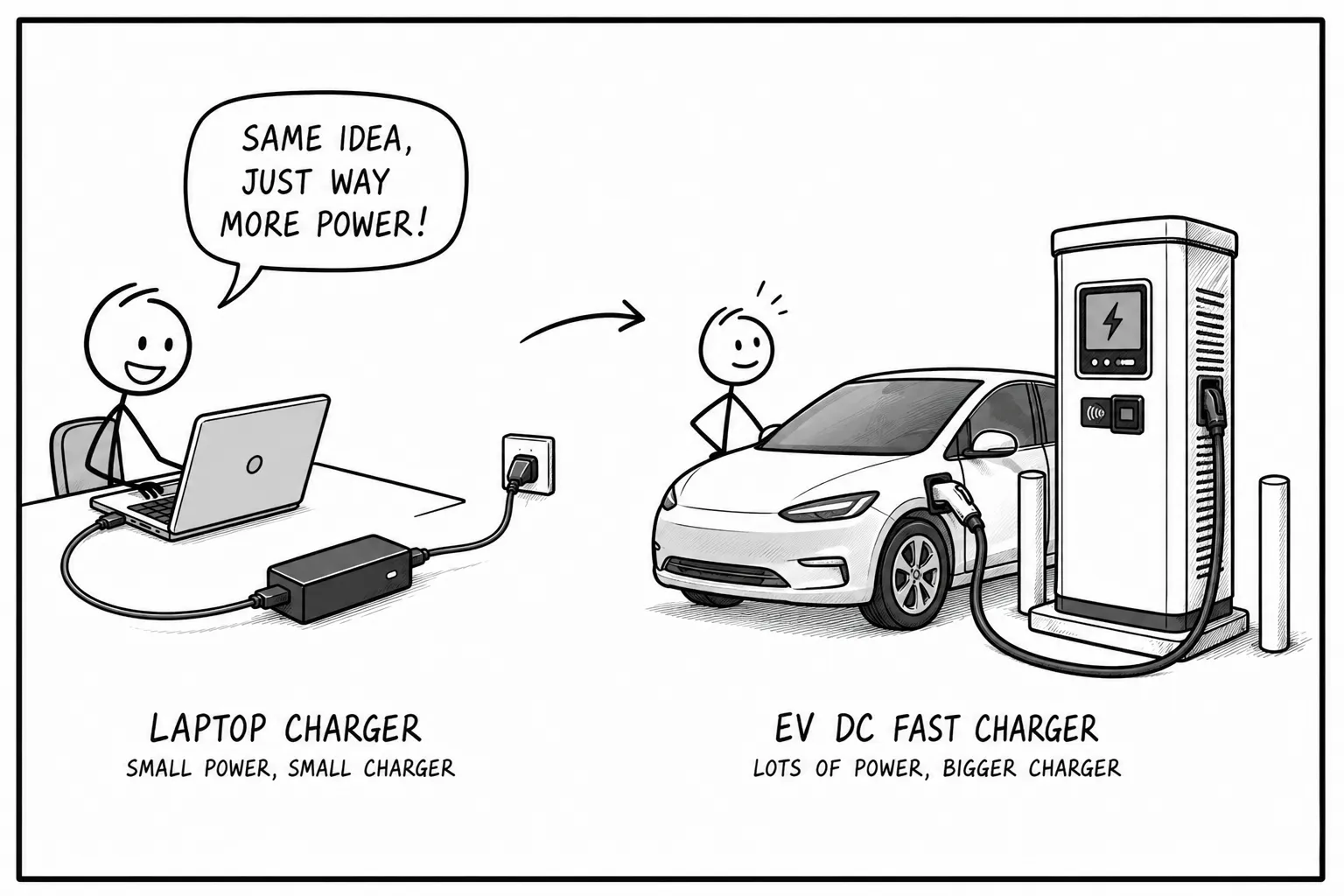
When you charge your laptop, you notice how the charger usually has a brick or is bulky. When you charge your phone, the charger that plugs into the wall is relatively small. The charger size depends on how much power the device needs.
That brick is an AC-DC converter. It takes AC from the wall and turns it into DC for your device. The more power it handles, the bigger it needs to be, because more power generates more heat that needs to be dissipated.
Now imagine an AC-DC converter that delivers thousands of times more power than a phone charger, enough to charge an electric vehicle. That is a very simplified explanation of a DC charging station.
What is it
There are two types of chargers explained here in AC vs DC Charging.
A DC charging station is in a nutshell a large AC-DC converter. It needs a cooling system to handle the heat generated by converting hundreds of kilowatts. It has a control board that manages the charging session and communicates with the vehicle. It has a payment terminal so drivers can tap a card. It has a display showing session progress. And it has a network connection to communicate with a backend system (CSMS) that handles authorization, billing, and remote management.
An AC charging station is much smaller because it doesn’t do the AC-to-DC conversion at all. It simply delivers AC from the grid to the vehicle through a cable. The vehicle’s onboard converter handles the rest. Because there’s no heavy conversion hardware and much less heat to deal with, an AC charger can be as small as a wallbox mounted on your garage wall.